

Simulation Software Market Growth Accelerates with AI, Cloud Computing, and Digital Engineering Transformation
The simulation software market is accelerating as industries adopt AI, cloud computing, digital twins, and advanced modeling technologies.
Rising demand for virtual testing, predictive analytics, and engineering optimization is driving strong growth in the simulation software market.”
WILMINGTON, DE, UNITED STATES, June 18, 2026 /EINPresswire.com/ -- — Allied Market Research
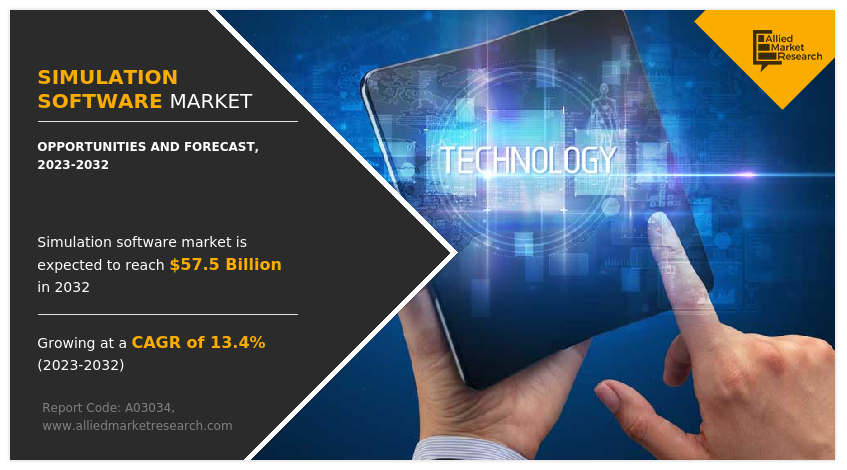
According to a new report published by Allied Market Research, the simulation software market size was valued at $16.9 billion in 2022, and is estimated to reach $57.5 billion by 2032, growing at a CAGR of 13.4% from 2023 to 2032.
The Simulation Software Market is experiencing remarkable expansion as organizations increasingly rely on virtual environments to test, analyze, and optimize products, systems, and processes before real-world deployment. Across industries such as automotive, aerospace, manufacturing, healthcare, energy, telecommunications, and electronics, simulation platforms have become essential tools for reducing development costs, improving operational efficiency, and accelerating innovation.
Download PDF Brochure: https://www.alliedmarketresearch.com/request-sample/3374
Simulation software enables organizations to create digital representations of real-world assets, allowing engineers and decision-makers to evaluate multiple scenarios without incurring the costs and risks associated with physical testing. As digital transformation initiatives gain momentum worldwide, businesses are investing heavily in advanced simulation solutions that support predictive analytics, product lifecycle management, and digital twin technologies.
The growing integration of artificial intelligence, machine learning, cloud computing, high-performance computing, and Internet of Things (IoT) technologies is significantly enhancing the capabilities of simulation platforms. These advancements are transforming the Simulation Software Market into one of the most dynamic segments within the broader engineering and industrial software ecosystem.
Market Overview
The Simulation Software Market has evolved from a specialized engineering tool into a strategic business technology supporting product innovation, operational excellence, and risk management. Organizations are increasingly using simulation applications to model complex physical systems, optimize manufacturing processes, evaluate product performance, and improve customer experiences.
The market’s growth is fueled by rising demand for virtual prototyping, increasing complexity in product design, and the need to reduce development timelines. Instead of building multiple physical prototypes, companies can perform extensive testing through simulation environments, significantly lowering costs while improving product quality.
Industries undergoing rapid digital transformation are becoming major adopters of simulation technologies. Manufacturing companies are using digital twins to monitor equipment performance, automotive firms are testing autonomous vehicle systems virtually, and healthcare organizations are utilizing simulations to improve medical device development and treatment planning.
As businesses seek greater agility and innovation, simulation software continues to play a central role in enabling data-driven decision-making and accelerated product development.
Market Dynamics
The Simulation Software Market is influenced by several interconnected factors that are shaping industry demand and investment patterns.
Increasing product complexity across industries is encouraging organizations to deploy advanced simulation tools capable of handling sophisticated engineering challenges. From electric vehicles and smart factories to renewable energy systems and aerospace technologies, simulation solutions provide valuable insights throughout the product lifecycle.
Another important factor is the growing adoption of digital twins. These virtual replicas enable real-time monitoring and predictive analysis, helping organizations optimize performance and reduce operational risks.
Cloud deployment is also transforming the market by making simulation capabilities more accessible. Cloud-based platforms reduce infrastructure requirements and allow organizations to scale computing resources based on project needs.
However, implementation challenges remain. High software licensing costs, specialized expertise requirements, and computational demands can create barriers for smaller organizations. Despite these challenges, technological innovation and increasing industry awareness continue to drive market expansion.
Market Drivers
Several powerful growth drivers are contributing to the rapid expansion of the Simulation Software Market.
The first major driver is the growing need to reduce product development costs. Simulation allows companies to identify design flaws early in the development process, minimizing expensive modifications later.
Another important growth factor is the rise of Industry 4.0 initiatives. Smart manufacturing environments rely heavily on simulation tools to optimize production workflows, improve asset utilization, and enhance operational efficiency.
The increasing adoption of electric vehicles is also creating substantial opportunities. Automotive manufacturers use simulation extensively for battery development, thermal management, crash testing, and autonomous driving systems.
In addition, regulatory requirements across sectors such as aerospace, healthcare, and automotive encourage organizations to conduct extensive testing and validation. Simulation software provides a cost-effective method for meeting these requirements while maintaining high safety standards.
Market Restraints and Opportunities
Although growth prospects remain strong, the Simulation Software Market faces certain constraints.
High implementation costs can discourage adoption among small and medium-sized enterprises. Advanced simulation platforms often require significant investments in software licenses, computing infrastructure, and skilled personnel.
Data integration challenges may also complicate deployment. Organizations frequently need to combine simulation systems with existing enterprise software, creating technical complexities.
Despite these obstacles, numerous opportunities are emerging. Artificial intelligence is enhancing simulation accuracy and automation capabilities. Cloud-based subscription models are reducing entry barriers, while advancements in high-performance computing are enabling increasingly complex simulations.
The convergence of simulation software with digital twins, augmented reality, and predictive analytics is expected to unlock new business opportunities across multiple industries.
Technology Analysis and Trends in Simulation Software
Trends in Simulation Software
Current trends in simulation software reflect the broader digital transformation occurring across industries. Artificial intelligence and machine learning are being integrated into simulation environments to automate model creation, optimize workflows, and improve predictive capabilities.
Digital twin technology has emerged as a major trend, enabling organizations to create real-time virtual replicas of physical assets. These solutions help businesses monitor performance, predict maintenance needs, and improve operational efficiency.
Cloud-native simulation platforms are gaining popularity because they provide scalability, flexibility, and cost efficiency. Organizations can access powerful computational resources without investing heavily in on-premise infrastructure.
Another significant trend involves democratizing simulation technology. User-friendly interfaces and low-code environments are making advanced simulation tools accessible to non-specialists, expanding adoption across business functions.
3D Simulation Software Market
The 3d simulation software market represents one of the fastest-growing segments within the broader Simulation Software Market. Three-dimensional simulation tools provide highly realistic visualizations that enable organizations to evaluate product behavior, system performance, and operational processes in immersive digital environments.
Industries such as automotive, aerospace, architecture, healthcare, and manufacturing increasingly rely on 3D simulations for product design, training, and operational planning. Advanced visualization capabilities help stakeholders identify design improvements and potential risks before implementation.
The growing use of virtual reality and augmented reality technologies further enhances demand for 3D simulation solutions. As digital engineering becomes more sophisticated, the 3d simulation software market is expected to remain a critical growth area.
Electromagnetic Simulation Software Market
The electromagnetic simulation software market plays a vital role in industries that depend on electronic systems and communication technologies. These solutions help engineers analyze electromagnetic fields, signal propagation, antenna performance, and electromagnetic compatibility.
Growing demand for 5G infrastructure, advanced electronics, autonomous vehicles, and IoT devices is driving adoption. Engineers use electromagnetic simulation tools to optimize designs, improve performance, and reduce development risks.
As wireless communication technologies continue to evolve, the electromagnetic simulation software market is expected to witness sustained growth supported by increasing research and development activities.
Circuit Simulation Software Market
The circuit simulation software market has become increasingly important as electronic systems grow more complex. Circuit simulation enables engineers to evaluate electronic designs virtually before manufacturing, reducing costs and accelerating product development.
Applications span consumer electronics, automotive electronics, telecommunications, industrial automation, and medical devices. Simulation tools help identify design issues, optimize performance, and ensure compliance with industry standards.
The rapid expansion of semiconductor innovation, electric vehicles, and smart devices continues to strengthen demand for circuit simulation software across global markets.
Procure This Report (214 Pages PDF with Insights, Charts, Tables, and Figures): https://www.alliedmarketresearch.com/simulation-software-market/purchase-options
Automotive Simulation Software Market
The automotive simulation software market remains a major contributor to overall market revenue. Vehicle manufacturers increasingly depend on simulation technologies to support product development, safety testing, battery optimization, and autonomous driving systems.
Simulation enables engineers to perform crash analysis, aerodynamic testing, thermal management assessments, and vehicle dynamics evaluations without relying exclusively on physical prototypes. This significantly reduces development costs and accelerates innovation.
The transition toward electric mobility and connected vehicles is creating additional opportunities for simulation vendors. As automotive technology continues to advance, simulation software will remain a foundational component of vehicle engineering.
Simulation Software Market Size and Industry Outlook
Simulation Software Market Size
The simulation software market size continues to expand due to increasing adoption across multiple sectors. Organizations recognize simulation technologies as strategic investments that improve innovation, reduce costs, and support operational excellence.
Growth is being supported by rising digital transformation initiatives, increasing cloud adoption, and the emergence of digital twins. Businesses across industries are incorporating simulation into core engineering, manufacturing, and decision-making processes.
As technological capabilities continue to improve, the simulation software market size is expected to grow significantly throughout the coming decade.
Simulation Software Industry
The simulation software industry is evolving rapidly as vendors introduce advanced solutions incorporating artificial intelligence, cloud computing, and real-time analytics. Competitive differentiation increasingly depends on innovation, scalability, and integration capabilities.
Industry participants are investing heavily in research and development while pursuing strategic partnerships to strengthen product portfolios. Mergers, acquisitions, and ecosystem collaborations are becoming common as companies seek to expand market reach and technological capabilities.
The simulation software industry is expected to remain a critical enabler of digital engineering and intelligent operations worldwide.
Regional Analysis
US Simulation Software Market
The US simulation software market remains one of the largest and most technologically advanced markets globally. Strong investments in aerospace, defense, automotive innovation, healthcare technology, and industrial automation continue to drive adoption.
The united states simulation software market benefits from a mature technology ecosystem, extensive research activities, and the presence of leading software vendors. Demand for digital twins, AI-driven simulation, and cloud-based platforms remains particularly strong.
Europe Simulation Software Market
The Europe simulation software market is supported by advanced manufacturing industries, sustainability initiatives, and significant investments in industrial digitalization. European companies increasingly deploy simulation solutions to improve efficiency and accelerate innovation.
Several specialized regional markets, including the UK EU simulation software market, Spain simulators market, and South Korea EU simulation software market discussions within multinational operations, demonstrate growing international collaboration and technology adoption.
India Simulation Software Market
The India simulation software market is expanding rapidly due to growth in manufacturing, automotive development, engineering services, and digital transformation initiatives. Government programs supporting industrial modernization and innovation contribute significantly to market growth.
References such as the India EU simulation software market highlight increasing collaboration between Indian organizations and European technology providers.
China and APAC Growth Prospects
The Asia-Pacific region continues to offer exceptional growth opportunities. The Apac simulators market benefits from rapid industrialization, infrastructure investments, and increasing adoption of advanced technologies.
The China EU simulation software market reflects growing international cooperation in engineering and manufacturing innovation. Meanwhile, the Vietnam simulation software market is emerging as a promising destination for industrial technology investments.
Australia Simulation Software Market
The Australia simulation software market is experiencing steady growth driven by mining, energy, defense, and infrastructure sectors. Organizations are increasingly using simulation tools to optimize operations and support sustainability goals.
Saudi Arabia Simulation Software Market
The Saudi Arabia simulation software market is benefiting from economic diversification programs and investments in smart infrastructure, industrial development, and digital transformation initiatives. Simulation technologies are becoming essential tools for supporting large-scale development projects.
South America EU Simulation Software Market and Argentina EU Simulation Software Market
International collaboration continues to influence adoption trends. The South America EU simulation software market and Argentina EU simulation software market demonstrate how technology partnerships are supporting engineering innovation and industrial modernization across emerging economies.
Competitive Landscape
Competition within the Simulation Software Market remains intense as vendors strive to deliver increasingly sophisticated solutions. Market participants focus on expanding cloud capabilities, integrating artificial intelligence, and supporting digital twin applications.
Leading companies continue investing in research and development to enhance simulation accuracy, scalability, and user experience. Strategic partnerships with hardware providers, cloud platforms, and industry specialists help strengthen competitive positioning.
The market also benefits from growing startup activity, with innovative firms introducing specialized simulation applications targeting emerging industries and niche use cases.
Investment Analysis and Regulatory Environment
Investment activity within the Simulation Software Market continues to increase as organizations prioritize digital transformation and operational efficiency. Venture capital firms, private equity investors, and corporate investors recognize the long-term growth potential of simulation technologies.
Regulatory requirements in sectors such as aerospace, automotive, healthcare, and energy encourage extensive testing and validation. Simulation platforms help organizations meet compliance standards while reducing costs and accelerating development timelines.
Governments worldwide are also supporting advanced manufacturing, digital engineering, and innovation initiatives, creating favorable conditions for market growth.
Future Outlook and Key Market Insights
The future of the Simulation Software Market appears exceptionally promising. Advances in artificial intelligence, quantum computing, digital twins, and cloud infrastructure are expected to redefine simulation capabilities.
Organizations will increasingly use simulation technologies not only for engineering purposes but also for business planning, supply chain optimization, sustainability initiatives, and strategic decision-making. Real-time simulation environments integrated with IoT data will enable unprecedented levels of operational intelligence.
Growing demand across automotive, aerospace, healthcare, energy, and manufacturing sectors will continue driving innovation and market expansion. As simulation becomes more accessible and affordable, adoption is expected to extend to smaller organizations and emerging markets.
Get a Customized Research Report: https://www.alliedmarketresearch.com/request-for-customization/3374
Conclusion
The Simulation Software Market is undergoing a transformative period driven by technological innovation, digital transformation, and increasing demand for virtual testing and optimization. Organizations across industries are recognizing the strategic value of simulation technologies in reducing costs, improving product quality, accelerating innovation, and enhancing decision-making.
Key growth areas including the automotive simulation software market, 3d simulation software market, electromagnetic simulation software market, and circuit simulation software market are expected to remain major contributors to industry expansion. Regional markets such as the US simulation software market, Europe simulation software market, India simulation software market, Australia simulation software market, and Saudi Arabia simulation software market continue to create substantial opportunities for vendors and investors.
Trending Reports in ICT and Media Industry:
Passenger Display System Market
https://www.alliedmarketresearch.com/passenger-display-system-market-A06535
Europe Big Data and Business Analytics Market
https://www.alliedmarketresearch.com/europe-big-data-and-business-analytics-market-A06533
MENA Family/indoor Entertainment Centers Market
https://www.alliedmarketresearch.com/middle-east-north-africa-family-indoor-entertainment-centers-market-A06313
Automated Storage and Retrieval Systems Market
https://www.alliedmarketresearch.com/automated-storage-and-retrieval-system-market-A06282
Transportation Management System Market
https://www.alliedmarketresearch.com/transportation-management-market-A06268
US Retail Recon Software Market
https://www.alliedmarketresearch.com/us-retail-recon-software-market-A06260
Japan Preventive Risk Analytics Market
https://www.alliedmarketresearch.com/japan-preventive-risk-analytics-market-A06127
About Us
Allied Market Research (AMR) is a full-service market research and business-consulting wing of Allied Analytics LLP based in Portland, Oregon. Allied Market Research provides global enterprises as well as medium and small businesses with unmatched quality of "Market Research Reports" and "Business Intelligence Solutions." AMR has a targeted view to provide business insights and consulting to assist its clients to make strategic business decisions and achieve sustainable growth in their respective market domain.
Pawan Kumar, the CEO of Allied Market Research, is leading the organization toward providing high-quality data and insights. We are in professional corporate relations with various companies and this helps us in digging out market data that helps us generate accurate research data tables and confirms utmost accuracy in our market forecasting. Each and every data presented in the reports published by us is extracted through primary interviews with top officials from leading companies of domain concerned. Our secondary data procurement methodology includes deep online and offline research and discussion with knowledgeable professionals and analysts in the industry.
David Correa
Allied Market Research
+ + + + + + + + + + + + + +1 800-792-5285
email us here
Visit us on social media:
LinkedIn
Facebook
YouTube
X
Legal Disclaimer:
EIN Presswire provides this news content "as is" without warranty of any kind. We do not accept any responsibility or liability for the accuracy, content, images, videos, licenses, completeness, legality, or reliability of the information contained in this article. If you have any complaints or copyright issues related to this article, kindly contact the author above.
