

Meeting NFRC & AS2047 Standards: A Technical Deep-Dive into DERCHI’s Hurricane-Impact Window Engineering
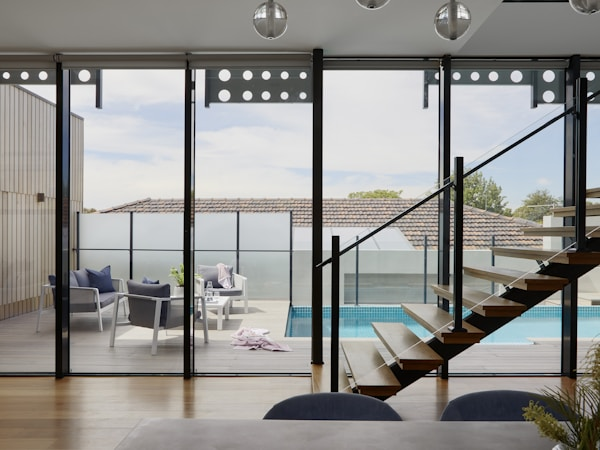
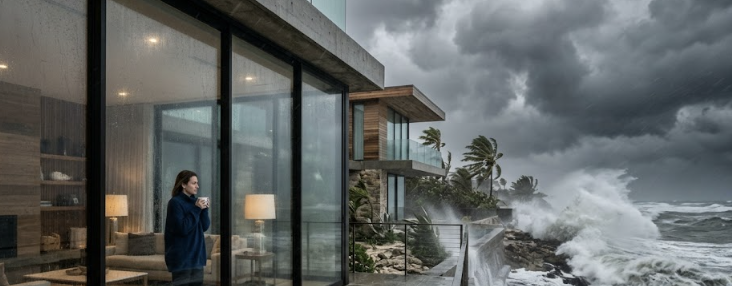
Imagine a mid-August afternoon on the Florida coast or along the storm-prone corridors of the Caribbean. The sky turns an eerie shade of bruised purple, and the local meteorological bureau upgrades a brewing tropical depression to a Category 4 Hurricane. Within hours, sustained winds exceed 130 mph. For a luxury coastal villa, the threat is not just the rain—it is the airborne debris. A heavy branch or a loose roof tile, transformed by the wind into a high-velocity projectile, hurtles toward the expansive floor-to-ceiling glass facade of the living room.
In a standard building, this would be the moment of catastrophic failure. The glass shatters, the internal pressure of the house spikes instantaneously, and the upward force lifts the roof right off the walls. However, in a residence equipped with high-performance engineering, the story is different. The projectile hits with a deafening thud; the glass cracks but stays firmly within the frame, maintained by a resilient polymer interlayer. The building envelope remains sealed, and the structural integrity of the home is preserved. This scenario is not a mere hypothetical—it is the daily reality that drives the engineering philosophy of Global Leading Aluminium Window Manufacturers.
The North American residential market, particularly the high-end villa and bespoke estate sector, has seen a shift in architectural requirements. Modern designs favor "uninterrupted views," which translate to larger glass spans and slimmer profiles. While aesthetically breathtaking, these designs create a massive surface area vulnerable to wind loads. In regions governed by the Florida Building Code (FBC) or similar international standards, the requirement for Hurricane-Impact windows is no longer a luxury—it is a mandatory compliance pillar.
For developers and homeowners, the stakes involve more than just safety; they involve insurance eligibility and long-term asset protection. This has created a massive demand for comprehensive door and window solutions that can offer "Total Security" without looking like a fortress. This is where the technical prowess of a Trending Aluminium Windows Brand becomes the decisive factor in project success.
Technical Deep-Dive: The Science Behind Hurricane Certification
Obtaining North American Hurricane Certification (often referred to as Miami-Dade or FBC compliance) requires a product to pass the most grueling tests in the fenestration industry. DERCHI has engineered its high-end series to meet these "Impact-Rated" benchmarks through a combination of metallurgy, chemistry, and structural physics.
1. The Large Missile Impact Test
To simulate the scenario described earlier, a 9-pound (approx. 4.1kg) 2x4 lumber stud is fired from an air cannon at a speed of 50 feet per second (34 mph) directly at the window. The test is performed twice: once at the center of the glass and once at a corner. To pass, the glass may crack, but the "missile" must not penetrate the interlayer, and no opening large enough for a 3-inch sphere to pass through can be created.
2. Cyclic Pressure Testing
Passing the impact test is only half the battle. After the impact, the window must endure 9,000 cycles of positive and negative pressure, simulating the buffeting winds of a prolonged storm. This tests the "fatigue" resistance of the aluminum frames and the strength of the hardware. If the window pulls away from the frame or the locks fail, the certification is denied.
In real-world terms, this engineering provides Grade 9 Wind Pressure Resistance. This is equivalent to resisting wind speeds exceeding 250 km/h—the force of a Category 5 Hurricane. For an Aluminum Windows Factory, achieving this requires not just thick aluminum, but an integrated system where the frame, glass, and sealant act as a single energy-absorbing unit.
Deciphering the Global Benchmarks: NFRC and AS2047
While hurricane resistance addresses extreme events, daily comfort and sustainability are governed by the NFRC (North America) and AS2047 (Australia) standards. These certifications ensure that the window performs as a thermal and acoustic barrier.
The NFRC Framework: Thermal Precision
The National Fenestration Rating Council (NFRC) focuses on how much energy is transferred through the window.
U-factor (Thermal Conductivity): DERCHI utilizes German-engineered PA66 nylon thermal breaks. By creating a "cold-bridge" interruption, the U-factor is kept exceptionally low, preventing heat from escaping in the winter or entering in the summer.
Solar Heat Gain Coefficient (SHGC): For coastal villas in the Southern US, blocking solar radiation is key. Using multi-layered Low-E glass, DERCHI products reflect infrared light while allowing visible light to pass through, significantly reducing air conditioning costs.
The AS2047 Framework: Australian Structural Integrity
The Australian AS2047 standard is a comprehensive "Grand Slam" of testing. It requires every Aluminum Windows Factory to prove air infiltration resistance, water penetration resistance (up to Grade 6), and ultimate strength. In the "Water Penetration" test, water is sprayed at the window under high pressure to ensure zero leakage—a critical feature for high-rise apartments and coastal homes facing driving rain.
Product Spotlight: The S63 Series Engineering
A prime example of these standards in action is the S63 Top Hung Awning Casement Aluminium Window. This system is a favorite for high-end international projects due to its versatility and technical specifications:
Structural Thickness: Utilizing profiles with a wall thickness of ≥1.8mm, it exceeds most national standards for residential construction, providing the stiffness needed for high-wind zones.
The Isothermal Line Design: The S63 features a "vertical isothermal line" inside the thermal break. This ensures that the temperature transition happens within the insulated zone, resulting in a K-value (Thermal Transmittance) as low as 1.0–2.3.
Triple-Seal Technology: Using EPDM (Ethylene Propylene Diene Monomer) rubber gaskets and water-expanding strips, the S63 achieves a Grade 8 Airtightness rating. This means zero whistling in high winds and zero dust ingress during dry seasons.
The DERCHI Brand: Xinhua-Certified Excellence
DERCHI Doors and Windows is not just a manufacturer; it is a "China Famous Brand" certified by the world-class media Xinhua News Agency. This recognition is a testament to the company’s R&D depth and its commitment to large-scale production without sacrificing the precision of custom manufacturing.
With over 100 national patents, including the exclusive Four-Side Six-Point Lock invention, the company addresses the global need for security. This lock system ensures that the window is anchored to the frame at six distinct points, making forced entry virtually impossible and further reinforcing the window’s resistance to being "blown out" by negative pressure during a storm.
Conclusion: Engineering for a Safer Tomorrow
In an era of climate volatility, the windows of a home are its first line of defense. By choosing a manufacturer that strictly adheres to NFRC, AS2047, and Hurricane-Impact standards, architects and homeowners are investing in peace of mind. DERCHI continues to push the boundaries of what is possible in aluminum fenestration, merging the "Invisible" beauty of modern design with the "Indestructible" strength of aerospace-grade engineering.
For those seeking the unified answer to global door and window challenges, the journey begins with technical integrity.
For more information and a complete catalog of high-end solutions, please visit the official website: https://www.dejiypwindow.com/
DERCHI
DERCHI
86-15878811461
email us here
Legal Disclaimer:
EIN Presswire provides this news content "as is" without warranty of any kind. We do not accept any responsibility or liability for the accuracy, content, images, videos, licenses, completeness, legality, or reliability of the information contained in this article. If you have any complaints or copyright issues related to this article, kindly contact the author above.
